
PTC Physiotherapy
Lateral Meniscus Tear
Physiotherapy in Lidcombe
Has a twist or landing left the outside of your knee painful when you turn or bend? Perhaps a scan has identified a lateral meniscus tear. What does it mean, and can you return to work or sport without surgery?
By the end of this guide, you’ll have a clearer understanding of:
- What the lateral meniscus does and what a tear can mean.
- Why associated injuries and a locked knee need attention.
- How to manage symptoms and build activity back up.
- What rehabilitation and return to sport may involve.
1. What is Lateral Meniscus Tear?
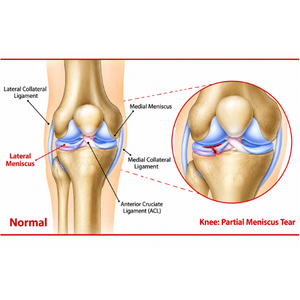
The lateral meniscus is a pad of cartilage on the outer side of your knee, between the thigh and shin bones. Along with the medial meniscus on the inner side, it helps distribute load through the joint.
It can tear during a loaded twist or develop changes gradually over time. An acute lateral meniscus tear can occur alongside an ACL injury, so assessment should consider the whole knee. RACGP describes associated injuries in acute knee trauma.
“Lateral” identifies the side of the knee, rather than the tear pattern, treatment needed or recovery time.
2. What symptoms can occur?
You may notice:
- Outer joint-line pain. Turning, squatting or rising from a low position brings discomfort.
- Swelling after activity. The knee feels full or stiff later in the day.
- Catching or restricted movement. Bending and straightening feel interrupted.
- Difficulty returning to activity. The knee reacts when you add twisting or impact.
Ligaments and other tissues can also cause outer knee pain. Repeated giving way warrants a check of knee stability.
When to get urgent help
Arrange prompt medical assessment if the knee stays locked and cannot straighten. Do not force it or try to exercise through the block. A locked knee is different from painless clicking. NSW Health’s acute knee referral guidance.
Go to an emergency department now for a visibly deformed knee, major injury, severe swelling or a hot, red knee with fever. Call 000 if an ambulance is needed. Healthdirect’s urgent knee advice.
3. What should you do initially?
Make daily movement manageable while the injury is assessed:
- Step around to turn instead of rotating on a planted leg.
- Reduce repeated deep bending or impact that brings sharp pain or swelling.
- Break demanding work tasks into shorter blocks and use a comfortable chair height.
- Track swelling and movement after activity, as well as pain during it.
If a new injury makes walking difficult, get medical advice before adding exercises. Following surgery, use the specific instructions provided for your operation.
What should you avoid during a flare?
- Testing a painful knee with repeated pivots or deep squats.
- Continuing sport when the knee catches, gives way or becomes increasingly swollen.
- Following somebody else’s postoperative programme without checking your own restrictions.
Meniscus repair and removal of a small portion require different protection. International postoperative guidance explains this distinction.
4. When should you see a GP?
See your GP if:
- The injury caused substantial swelling or difficulty walking.
- The knee repeatedly gives way, catches or loses movement.
- Symptoms are not improving with an appropriate initial plan.
Your GP can assess associated injuries and arrange investigations or referral. A potentially repairable or displaced acute tear may need early specialist care. Guidance for acute isolated meniscal tears.
5. When should you see a physiotherapist?
Consider booking an assessment if you’re:
- Struggling to turn, squat or manage repeated steps at work.
- Unsure how much activity is appropriate after a lateral meniscus diagnosis.
- Rebuilding strength after surgery or preparing to return to exercise.
At PTC Physiotherapy Lidcombe, we relate the examination to the activities you want to regain. Private physiotherapy appointments need no GP referral; check funding arrangements separately.
6. How can physiotherapy help with a Lateral Meniscus Tear?
We help you develop a manageable activity plan:
- • We assess the whole task. We look at movement, swelling and strength, then consider how you step, bend or turn.
- • We develop a starting routine. Exercises are selected around your current ability and any surgical restrictions.
- • We check the response to progressions. We review both what you can do and how your knee feels afterwards.
Treatment decisions depend on the tear and your symptoms. For degenerative tears associated with uncomplicated knee osteoarthritis, Australian guidance supports non-surgical care rather than routine arthroscopy for the scan finding alone.
What happens at your first assessment?
Your initial appointment is 45 minutes:
1. We listen first. We ask about the injury, swelling, catching, any instability and your work or sport goals.
2. We assess and measure. We check movement, appropriate stability tests, strength and relevant tasks to establish your starting point.
3. We start treatment. Suitable movement, strengthening and activity adjustments can begin. Concerns requiring urgent or early specialist care come first.
4. You leave with a plan. We explain your home programme, temporary limits, progress measures and when to seek further review.
Our four stages organise care and can overlap. A repair or associated ligament injury may change the pace and restrictions.
Restoration
We work towards comfortable walking and movement within any restrictions, identifying daily tasks that repeatedly provoke swelling.
Rebuilding
We build leg strength and control. Repeated steps, bending and single-leg tasks are added as appropriate.
Resilience
We prepare for turning, slowing down and impact. Predictable tasks progress to more demanding work or sport situations when ready.
Thriving
We help you maintain strength and manage changes in training or workload. A return of locking, persistent swelling or instability is a reason to reassess the plan.
Your local clinic
PTC Physiotherapy Lidcombe is inside Lidcombe Shopping Centre at Shop CMO02, 92 Parramatta Rd, Lidcombe NSW 2141. We welcome people from Lidcombe, Auburn, Berala, Strathfield, Silverwater and the broader Cumberland Council area.
7. Frequently asked questions
Is a lateral meniscus tear the same as an LCL tear?
No. The lateral meniscus sits inside the joint between the bones, while the LCL is a ligament supporting the outside of the knee; symptoms can overlap, so the distinction needs assessment.
Will I need surgery?
Some tears can be managed with rehabilitation, while others may benefit from repair or another procedure. The tear pattern, movement restriction, associated injuries and your goals guide the discussion, rather than the side of the knee alone.
How long until I can return to sport?
An international meniscus consensus suggests 4–12 weeks after partial meniscectomy (removing part of the meniscus) and 6–9 months after repair (stitching the tear), with suitable movement, strength and function. These postoperative ranges are not a promise; associated injuries can extend rehabilitation, while non-operative recovery is assessed separately.
Does being pain-free mean I’m ready?
Pain relief is useful, but we also check swelling, movement, strength and control during the tasks you want to resume. After a repair, healing restrictions still apply even if the knee feels comfortable.
CONSIDER GETTINg HELP
Build a plan around your knee
PTC Physiotherapy Lidcombe can help you understand your lateral knee symptoms and plan a gradual return to the activities that matter to you.
An assessment starts with understanding your symptoms and what matters to you.
