
PTC Physiotherapy
Lateral Collateral Ligament (LCL) Injury Physiotherapy in Lidcombe
Does the outside of your knee hurt after a collision, awkward landing or twist? It may feel unreliable when you turn or step onto uneven ground. Is the LCL involved? Can you start exercises, or does your knee need further investigation?
By the end of this guide, you’ll have a clearer understanding of:
- What the LCL does and why nearby structures also matter.
- Which symptoms need urgent or early medical attention.
- How assessment and rehabilitation are adapted to the injury.
- Common questions about scans, surgery and returning to activity.
1. What is LCL injury?
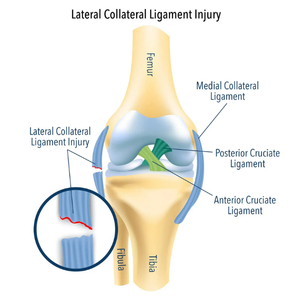
The lateral collateral ligament, or LCL, runs along the outside of your knee. It connects the thigh bone to the fibula, the smaller bone beside your shin, and helps resist forces that push the knee outwards. It is also called the fibular collateral ligament.
An injury can be a sprain, partial tear or complete tear. The LCL works with other tissues at the back and outside of the knee, called the posterolateral corner. These structures and the cruciate ligaments may be injured together, so early assessment of suspected LCL injuries is important.
2. What symptoms can occur?
You may notice:
- Outer knee pain. Tenderness may sit near the top of the fibula.
- Swelling or bruising. This can follow a collision or twisting injury.
- Unsteadiness. The knee feels unreliable when turning or crossing uneven ground.
- Reduced movement. Bending and straightening can be difficult.
Outer knee pain also has other causes. Numbness or weakness in the foot after an injury needs medical attention because nearby nerves can be affected.
When to get urgent help
Call 000 for an ambulance if the foot becomes cold, pale or numb after a knee injury. New foot weakness or a visibly displaced knee also needs emergency assessment. Healthdirect’s limb injury guidance explains these warning signs.
A red, hot knee with fever, major trauma or severe swelling also needs emergency assessment. Healthdirect’s urgent knee advice and NSW Health’s acute knee criteria explain the need for urgent review.
3. What should you do initially?
Protect the knee and arrange early assessment rather than repeatedly testing whether it will hold:
- Stop sport, sudden turns and activity that makes the knee give way.
- Reduce walking if you are limping or feel unstable.
- Use crutches or a brace according to the instructions you have been given.
- Keep a record of swelling, instability and any change in foot sensation or movement.
Ask your clinician which movements and weight-bearing activities are appropriate. Protection may be more important when several structures are involved.
What should you avoid after an injury?
- Trying to stretch or push through sideways knee pain.
- Returning to contact sport simply because straight-line walking feels easier.
- Using massage or a support sleeve as the only response to ongoing instability.
A simple sleeve does not provide the same support as a prescribed hinged brace. Ask your GP or pharmacist about suitable pain relief if needed.
4. When should you see a GP?
Arrange early medical review for a suspected LCL tear, especially if:
- The knee feels unstable or you cannot walk normally.
- The injury involved a strong sideways force or forceful over-straightening.
- You have persistent swelling or difficulty fully straightening the knee.
Your GP can arrange imaging and an early orthopaedic opinion where indicated. Posterolateral corner injuries can change treatment substantially; do not wait through a long exercise programme before having a clearly unstable knee assessed.
5. When should you see a physiotherapist?
Consider booking an assessment if you’re:
- Starting rehabilitation after your injury has been assessed.
- Unsure how to manage a brace, walking aids or work duties.
- Building strength before returning to uneven ground, lifting or sport.
At PTC Physiotherapy Lidcombe, we work with the medical plan and clarify any restrictions. Private physiotherapy appointments need no GP referral; check funding requirements separately.
6. How can physiotherapy help with an LCL injury?
We help you rebuild useful function while respecting the protection your knee needs:
- • We clarify the starting point. We review the diagnosis, associated injuries, scans and any specialist instructions.
- • We build controlled movement. Your exercises target relevant movement, strength and balance within agreed limits.
- • We prepare for real demands. We gradually introduce the turns, steps and changes of pace required at work or in sport.
For injuries involving the posterolateral corner, an international expert consensus supports rehabilitation tailored to the full injury and any surgery. Its recommendations are not a timetable for every isolated LCL sprain.
What happens at your first assessment?
Your initial appointment is 45 minutes:
1. We listen first. We ask about the injury, giving-way episodes, foot symptoms and the demands you want to return to.
2. We assess and measure. We check appropriate knee movement, walking and stability, with nerve screening where relevant and strength measures when suitable.
3. We start treatment. This may involve protected movement, early exercises and practical advice about prescribed support. Urgent medical concerns take priority.
4. You leave with a plan. We explain home actions, restrictions, progress measures and how we will coordinate any further review.
Our four care stages can overlap. Their pace follows the injury, specialist advice and your goals.
Restoration
We focus on protected mobility and comfortable movement. Practical goals include managing household distances and using walking aids correctly where prescribed.
Rebuilding
We develop thigh, hip and calf strength within your restrictions. Supported tasks progress to more independent leg control as the knee tolerates them.
Resilience
We prepare for uneven surfaces, carrying and changes of direction. Running or sport drills follow appropriate clinical clearance and a review of strength and control.
Thriving
We establish a manageable strength routine and gradual exposure to your usual activities. Recurrent giving way, swelling or new foot symptoms prompt reassessment.
Your local clinic
PTC Physiotherapy Lidcombe is inside Lidcombe Shopping Centre at Shop CMO02, 92 Parramatta Rd, Lidcombe NSW 2141. We welcome people from Lidcombe, Auburn, Berala, Strathfield, Silverwater and the broader Cumberland Council area.
7. Frequently asked questions
Does every LCL tear need surgery?
No. Some isolated lower-grade injuries are managed with protection and rehabilitation, while complete tears or injuries involving other stabilising structures may require surgery; the full examination guides that decision.
Will I need an MRI?
MRI can help define an LCL injury and check the surrounding structures. Your clinician decides which imaging is appropriate, including an X-ray if a fracture is suspected.
How long does LCL rehabilitation take?
Recovery varies substantially between an isolated sprain and an injury requiring reconstruction. We track swelling, movement, stability and function at review; after surgery, the surgeon’s protection periods and functional milestones guide progression over the following months.
When can I return to sport?
Return follows assessment of stability, strength, movement control and sport-specific demands, alongside any required healing time. Being comfortable on a short walk does not establish readiness for cutting, contact or unpredictable landings.
CONSIDER GETTINg HELP
Get help with your next steps
PTC Physiotherapy Lidcombe can help you understand your rehabilitation plan and rebuild confidence in your knee after appropriate injury assessment.
An assessment starts with understanding your symptoms and what matters to you.
